Otsuka Lotec No.8: the mixing console that rocked GPHG 2026
A Miyota calibre, a 62 part in house module and minutes shown on a console fader: Jiro Katayama's Otsuka Lotec No.8 wins the Petite Aiguille Prize at GPHG 2026. A look at an unobtainable watch and its market.
On November 7, at Geneva's Bâtiment des Forces Motrices, the 26th Grand Prix d'Horlogerie de Genève awarded the Aiguille d'Or to Rexhep Rexhepi and his Chronograph Flyback. Yet for many enthusiasts, the most joyful moment of the evening came a little earlier, in the Petite Aiguille category. The prize went to a rectangular Japanese watch, powered by a Miyota calibre and designed like a mixing console: the Otsuka Lotec No.8.
A watch you read like a studio console
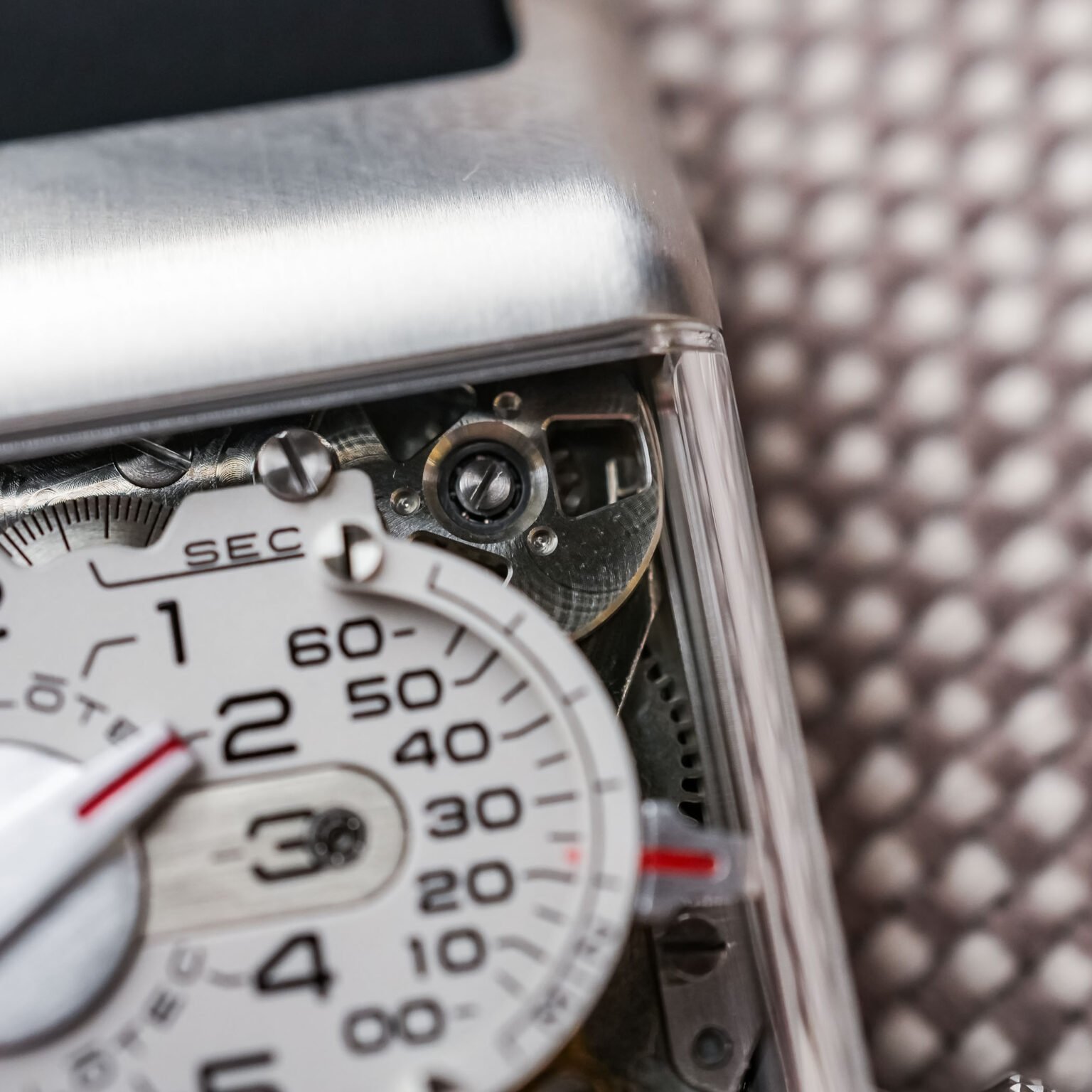
What sits under the sapphire is not really a dial, but rather an aluminium control panel. On the left, an hour “channel” numbered 1 to 12. On the right, a vertical “fader” graduated from 00 to 60 that serves as the minute hand. At the top, a seconds disc turns continuously, like a VU meter. The show happens once an hour: when the fader reaches 60, it snaps back to zero in a retrograde motion damped by a small flywheel, and the hour jumps at the very same instant. Both functions are mechanically linked and act together.
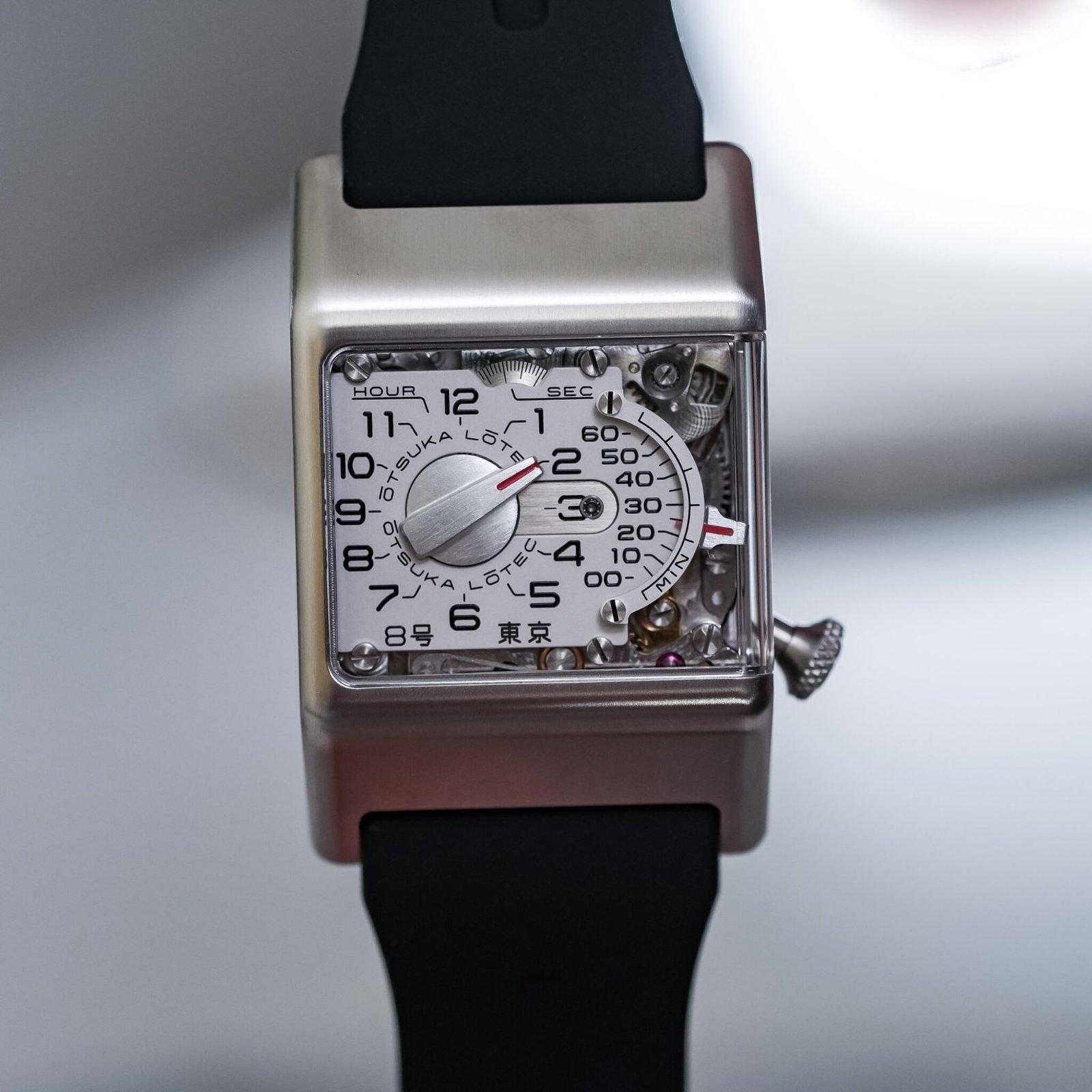
Behind the theatre, the engineering is serious. The base is an automatic Miyota 90S5 beating at 4 Hz, onto which Otsuka Lotec fits an in house module of 62 components, nearly twice as many as in its earlier modules. The flywheel and the minute arm run on ball bearings, including an ultra miniature 1.5 mm bearing made by MinebeaMitsumi. The satin finished steel case measures 31 mm wide, 47.8 mm long and 10.8 mm thick, and according to Monochrome's hands on review, it wears nicely even on a 16 cm wrist. One detail says everything about the brand's philosophy: there is no lume. This is an instrument, not a dive tool.
From an auction lathe to the Geneva podium
Nothing destined Jiro Katayama for watchmaking. A car designer turned product designer, he recalls impulse buying a small bench lathe on an online auction around 2008, and learned the craft largely on his own. The brand was born in 2012 in Tokyo's Otsuka district, and its name sets out a programme: “Lotec”, for low tech. For years, Otsuka Lotec remained an artisanal project made in tiny numbers.
The turning point came with Hajime Asaoka, founder of Kurono Tokyo, who brought the brand under Precision Watch Tokyo in 2022. Katayama still designs his prototypes at home, but production now benefits from a proper workshop, watchmakers and better suppliers. Recognition followed quickly: in 2024, the No.6 had already won the GPHG Challenge Prize, reserved for watches under CHF 3,000. Two years later, the brand wins in the category above, for watches priced between CHF 4,500 and CHF 10,000, against competition including Christopher Ward and TAG Heuer. Few independents can claim that kind of progress in so little time.
A symbolic retail price, a very real market
In Japan, the No.8 is listed at 990,000 yen including tax, or roughly 5,400 euros. On paper, it is one of the most affordable watches on the 2026 prize list. In practice, almost nobody pays that price. Otsuka Lotec makes fewer than 200 watches a year and allocates them by lottery, open to Japanese customers only. For a European collector, the only way in is the secondary market.
And that market speaks clearly. At Phillips, a No.5 estimated at CHF 5,000 to 10,000 soared to CHF 21,590. A recent No.7.5 sold there for HK$53,340, above its high estimate. Among dealers, an unworn No.7.5 is listed around $8,150 and a No.5 Kai approaches $16,000, often two to three times the original price. We have not yet recorded a public transaction for the No.8, but the logic is familiar: tiny production, closed distribution and now a GPHG trophy are the classic recipe for a rising valuation. Basic caution still applies: a scarcity premium is not a guarantee of value, and the enthusiasm for Japanese independents will have to last. We will track its evolution in the Osterman index.
Why this prize matters
The No.8's win sends a useful message to the whole industry. A mass produced calibre, provided it is dressed with a real idea and a well designed module, can beat established houses on their own turf. Creativity is not measured by the price of the base movement, and the jury chaired by Wei Koh recognised it. For those who want to see the watch up close, the 84 finalists are on display at Geneva's Musée d'Art et d'Histoire until November 15, before a stop in London from November 18 to 23 at Watches of Switzerland in Knightsbridge. More information on the official Otsuka Lotec website.