Richemont Group Financial Analysis: Autumn 2025
Richemont reports strong 2025 results with sales up 4% and net profit rising 16.8%. This analysis highlights the dominance of jewellery, the challenges facing watchmaking, and the group's strategic outlook amid headwinds in China and opportunities in the US, Europe, and the Middle East.
In 2025, Richemont confirmed the strength of its business model, reporting sales of €21.4 billion for the financial year ending in March, up 4% despite the slowdown in the Asian market. Net profit reached €2.75 billion, a 16.8% increase driven by the performance of jewellery, which grew by 8%. The group chose to increase its dividend by 9% to CHF 3 per share, a sign of confidence in its resilience. The first quarter of the new financial year, from April to June 2025, confirmed this momentum with sales of €5.4 billion, up 3% at actual exchange rates and 6% at constant exchange rates, reflecting continued positive growth in an unstable environment.
Geographically, performance remains mixed. Asia-Pacific was the only region to decline in 2024/25, down 13% due to the Chinese slowdown. Conversely, all other regions grew significantly: Europe posted a 10% increase thanks to the return of tourism and high jewellery events, Japan surged by 25%, the Americas gained 16%, and the Middle East and Africa grew by 15%, boosted in particular by Dubai. These trends continued into the first quarter of 2025/26, with solid increases in Europe (+11%), the Americas (+17%), and the Middle East (+17%), while Japan fell by 15% after an exceptional year, and Asia-Pacific stabilised, with weakness in China offset by South Korea and Australia.
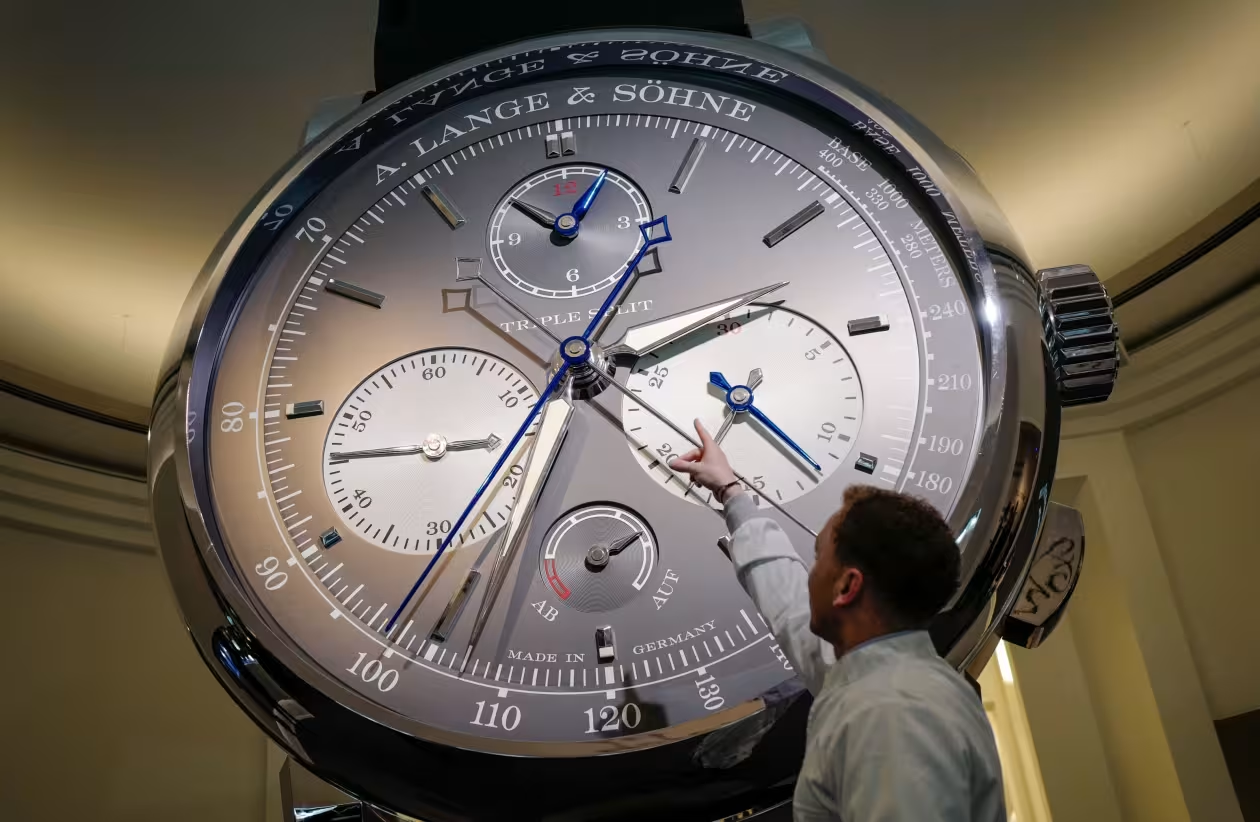
By segment, jewellery dominates by a wide margin, with sales of €15.3 billion and an operating margin close to 32%, confirming Cartier and Van Cleef & Arpels as the group's pillars. Watchmaking, with €3.3 billion in sales, fell by 13% and posted a low profitability of 5%, reflecting the difficulties faced by specialist watchmakers such as Jaeger-LeCoultre, IWC, and Panerai. The fashion and accessories division, which includes Montblanc, Chloé, and Delvaux, accounted for €2.8 billion (+7%) but remains loss-making with a negative margin of 3.7%. Richemont's model thus appears highly polarised, with jewellery accounting for nearly three-quarters of sales and the bulk of profits, while watchmaking suffers from competition and Asian weakness.
This reality explains the strategic refocusing underway. In March 2025, the “Specialist Watchmakers” division was dissolved to give watch brands more autonomy and simplify the structure. At the same time, the group is stepping up its investments in retail, production, and the transmission of expertise. In terms of governance, a milestone was reached in June 2024 with the appointment of Nicolas Bos, former CEO of Van Cleef & Arpels, as sole Chief Executive Officer, marking increased centralisation and a clear focus on jewellery. The executive committee was expanded to include the heads of Cartier and Van Cleef. Richemont also strengthened its portfolio with the acquisition of Vhernier in 2024, enriching its jewellery offering, while selling YOOX Net-a-Porter to MyTheresa in 2025 to shed a loss-making digital burden and refocus on its core business.
However, significant challenges remain. The Chinese market remains fragile and weighs heavily on watch sales, and growing dependence on the United States exposes Richemont to risk in the event of a US economic slowdown. Competition is intense, with Swiss watchmaking profits largely captured by Rolex, Patek Philippe, and Audemars Piguet. Yet opportunities are real in jewellery, where Cartier and Van Cleef benefit from sustained demand and strong pricing power. The Middle East and India are emerging as promising growth drivers, and targeted digital partnerships offer an alternative to in-house e-commerce.

On the stock market, Richemont shares reached a peak of CHF 187 in February 2025 before correcting to a range of CHF 130 to CHF 140 over the summer, due to concerns over China and a more cautious climate in the luxury sector. As of 30 August, the share price stood at CHF 139, virtually flat year-on-year. Despite this volatility, analysts remain confident in the medium term, highlighting a net cash position of €8.3 billion and the group's dominance in jewellery. With a dividend yield of around 2%, Richemont retains an attractive defensive profile.
Ultimately, Richemont now rests on a solid but polarised foundation: jewellery drives growth and ensures profitability, while traditional watchmaking must reinvent itself. The group is adapting its governance, simplifying its structure, and investing in its flagship brands. The future will largely depend on developments in the Chinese market and the ability to revitalise its watchmaking houses, but the power of Cartier and Van Cleef, geographic diversification, and financial discipline provide robust foundations to maintain a sustainable growth trajectory.