Swiss Watchmaking in 2025: Between Global Stagnation and a Shifting World Market
The Swiss watch industry is undergoing a major transition in 2025. Stagnant exports, a decline in Asia, an American recovery, and a rebalancing of the global market. A comprehensive economic analysis.
The Swiss watch industry is at a turning point in 2025. After two years of digesting the post-euphoria boom, the economic mechanics have shifted. The market is no longer behaving as it did in 2021 or 2022, and the figures for the first half of 2025 confirm this clearly. Exports reached 12.9 billion francs, representing virtually flat growth compared to last year, with a minor decline of 0.1 percent. At the same time, volumes fell by nearly six percent, dropping to around seven million exported watches.
This apparent stagnation actually masks a profound transformation of the global market. Geographical flows have shifted, and demand is no longer distributed as it once was.
China continues to struggle under the weight of a prolonged real estate crisis and weakened consumer sentiment, losing another 3.2 percent to fall to 931 million francs for the half-year. Hong Kong collapsed even more violently, with an 18.7 percent drop. Together, this is disrupting the Asian center of gravity that has dominated the industry for the past decade. The correction is no longer cyclical: it is becoming structural. Brands are paying the price in the most speculative segments. Local Chinese demand remains weak, tourist spending has not restarted as hoped, and Asian retailers are clearing their inventory much more slowly.
This slowdown is leading to a natural deflation of prices on certain highly exposed references: sports watches from Audemars Piguet or Patek Philippe, as well as several Rolex models that had benefited from the 2020-2022 boom.

While Asia contracts, the United States is keeping the industry on track. The US market jumped by more than 20 percent and now accounts for nearly 20 percent of global exports. The American consumer remains the engine of the Swiss industry, despite restrictive monetary policy and a volatile dollar. Today, it is the most stable and resilient market. It absorbs watches at a pace that Europe cannot match, even though Europe is showing solid resilience, driven by France, Italy, and the United Kingdom.
The American recovery compensates for the Asian decline, but not enough to restart overall growth. This creates an impression of stagnation, whereas the actual dynamic is highly polarized.
In this context, different segments are reacting in different ways. Precious metal watches are up slightly in value, with a 2.5 percent increase, even as volumes decline. The non-speculative high-end segment is clearly fulfilling its role as a safe haven. Conversely, steel is down slightly in value, even though volumes are up. This confirms a natural shift in consumer preference toward more reasonable average price points. Mainstream brands and houses capable of telling a strong story are performing well. Tissot, Cartier, and Tudor are gaining market share, while ultra-premium references dependent on hype continue to normalize.
Secondary market data reinforces this reading. The pre-owned market now acts as a leading indicator for the industry. The year 2025 appears to be a time of redistribution rather than a period of crisis. Prices are stabilizing for watches with strong organic demand. Declines persist only for models whose prices had been artificially inflated by speculation. Standard Submariner, Santos, Speedmaster, or classic Royal Oak models maintain solid liquidity, while more extravagant or overvalued models continue to decline.
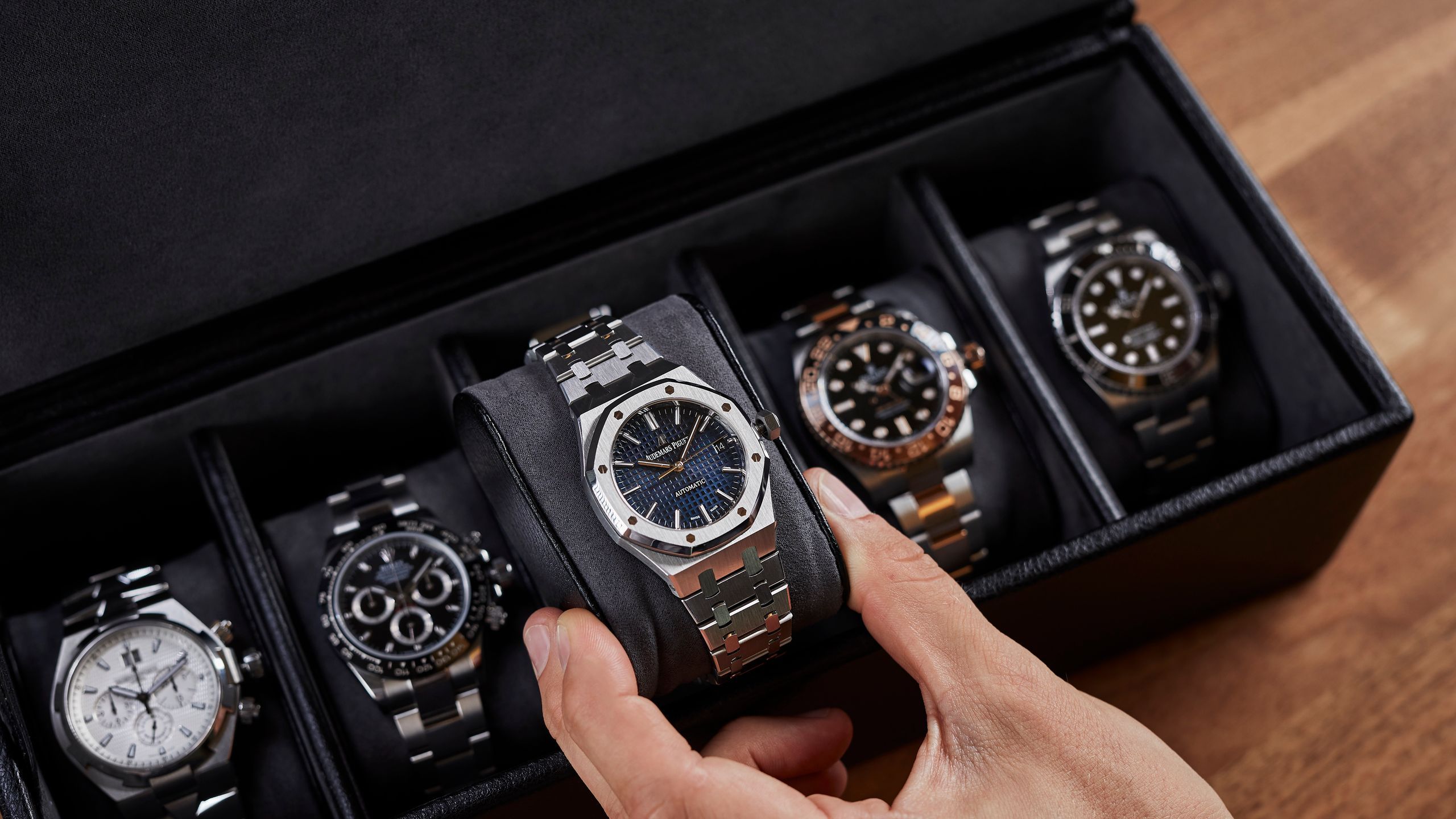
This new balance creates a healthier, more rational market, allowing brands to calibrate their production without repeating the excesses of recent years.
The industry is therefore entering a new cycle. It is moving out of the era of globalized FOMO and returning to a traditional macroeconomic logic where fundamentals take over once again. The US economy is supporting the whole. China is no longer playing its role as an engine of growth. Europe is absorbing the shocks as best it can. Brands with a strong identity and a clear strategy are gaining the upper hand, while those that relied solely on artificial scarcity will continue to correct until they find a price aligned with real demand.
2025 is not a year of crisis. It is a year of transition. Swiss watchmaking is not collapsing: it is readjusting. It is entering a longer, more stable, and much more selective cycle. The industry is refocusing on value, product range consistency, and finer volume management. After a boom and then a correction, the objective is now simple: to support a global market undergoing profound change, without getting sucked into the extreme dynamics of previous years.